

Make Your Festival Plastic-Free Without Losing the Fun
If you’re currently planning a festival for 2026, chances are sustainability is already on your checklist. Maybe it’s driven by regulation, brand commitments, sponsor expectations, or simply the fact that audiences are paying closer attention. Either way, the direction is clear: festivals are moving away from conventional plastic.
The challenge is that festivals still depend on single-use items to operate. Every drink served, every snack handed over, every person entering the site relies on packaging, access systems, and fast service. That’s why even festivals that aim to be “plastic-free” often struggle to remove plastic completely. The biggest waste does not come from one dramatic item, but from the everyday essentials that are used thousands of times in a weekend.
So, the real question becomes: how do you remove plastic without disrupting the festival experience? That’s where Solinatra fits in.
Why Festivals Still Struggle to Go Plastic-Free?
The festival environment is intense. Packaging has to be lightweight, strong, and reliable, and it has to work under pressure. Food and drinks are served quickly, in crowds, often outdoors, and often in unpredictable weather. The materials need to hold shape, withstand handling, and stack efficiently for vendors.
Conventional plastic has dominated for a reason: it performs.
But performance is not the only requirement anymore. In 2026, organisers are expected to deliver both functionality and sustainability. And “recyclable” claims are increasingly challenged in real-world festival settings. When waste is mixed, when bins overflow, when people throw things away quickly, recycling systems rarely work as intended.
For festivals, “plastic-free” is not about removing convenience. It’s about changing what convenience is made from.
The Solinatra Solution: Festival Essentials Without Conventional Plastic
Solinatra is a compostable material designed for single-use applications. It is engineered to perform like plastic, while being made from natural inputs. This means festivals can keep the formats they rely on — rigid cups, trays, lids, and small components — but replace the material with a 100% natural, zero-microplastic, compostable and biodegradable alternative.
One of the biggest advantages in a festival environment is what happens after use. At festivals, packaging waste is rarely “clean.” Cups and trays are often mixed with leftover drinks, sauce, grease, and food scraps. That’s exactly where recycling systems break down, because traditional recycling requires the packaging to be separated and relatively clean. In real festival conditions, that is difficult to achieve at scale.
Solinatra is designed to be composted and degraded together with food and beverage waste. This means cups, trays, lids, and straws can be disposed of in the same stream as the leftovers they carry. Instead of forcing visitors and vendors to separate packaging from messy waste, festivals can simplify disposal into a more practical system. In a high-volume setting where speed matters, this approach can make sustainable waste handling easier, cleaner, and more realistic.
Importantly, Solinatra products are designed to still look and feel premium. They do not look like paper or fibre packaging. They have a clean, modern finish with a subtle natural texture, which helps communicate sustainability without making the product feel “rough” or low quality.
What Solinatra Can Replace in a Festival Setting
A plastic-free festival isn’t achieved by changing one product. It happens when the key single-use items across operations are addressed — especially the items used at the highest volume, every hour of the event.
Solinatra can be used to produce:
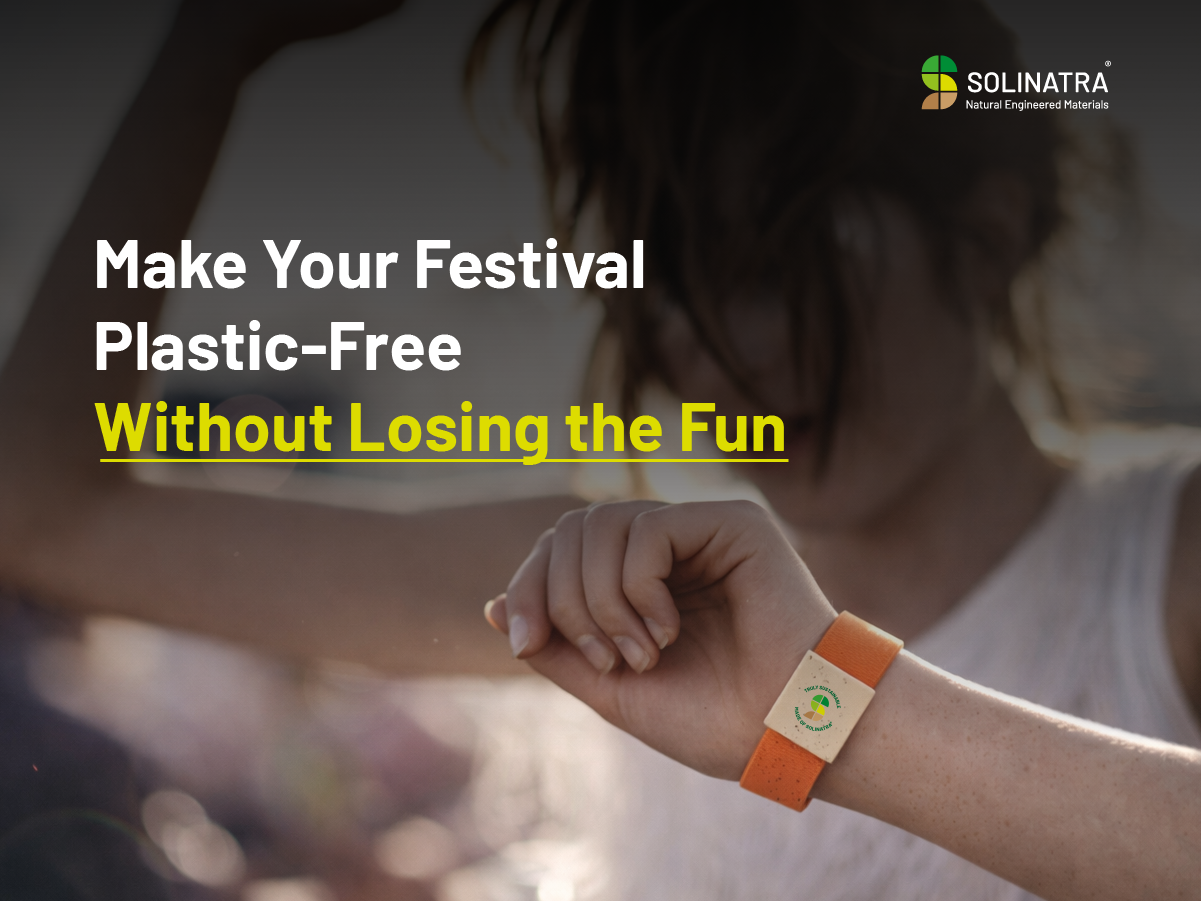
Wristband Chips

Compostable and biodegradable wristband chip made of Solinatra
Wristbands are often overlooked when festivals talk about plastic waste, even though almost every visitor, staff member, and crew member wears one. These chips are used for entry, access control, and sometimes cashless systems, and they are typically discarded immediately after the festival.
Solinatra can be used to produce rigid wristband chips that still look modern and durable, while being made from natural materials. They can also be coloured with natural colouring and printed, including festival branding, text, and QR codes, allowing organisers to keep the same functionality and customisation they already use today.
Food Trays
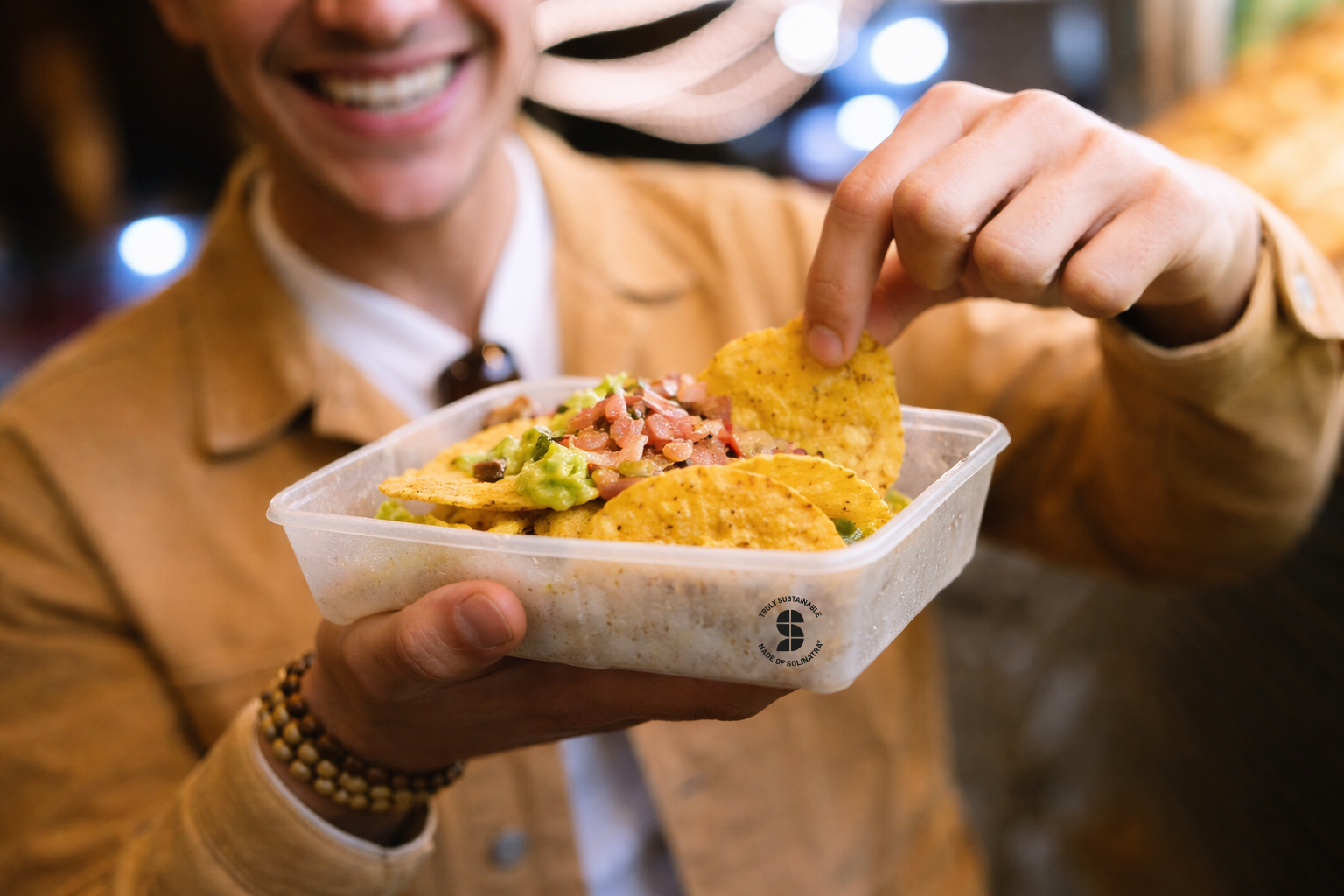
Compostable and biodegradable food tray made of Solinatra
Rigid trays are one of the most common packaging formats at festivals because they need to hold food securely in crowded conditions and allow vendors to serve quickly. Typical festival foods like fries, burgers, loaded nachos, hot dogs, and street food portions rely on trays that are strong, lightweight, and easy to stack.
Solinatra trays are designed for high-volume service and offer the same practical performance as conventional plastic trays, while enabling festivals to replace plastic with compostable alternatives.
Drinkware (Cups, Lids, and Straws)

Compostable and biodegradable cups, lids, and straws made of Solinatra
The drink system is one of the largest waste streams at any festival. Beer, cocktails, soft drinks, lemonades, iced coffee, and water are served continuously, often requiring lids and straws depending on the drink format.
Solinatra supports a complete drinkware set, allowing festivals to replace plastic consistently across every beverage serve. The cups are designed to perform like plastic, while offering a distinctive translucent finish and subtle natural texture that signals a more sustainable material choice without changing the visitor experience.
What Changes for Visitors and Vendors?
The goal of a plastic-free system is not to make things harder. Festivals are fast-moving environments, and vendors need packaging that simply works.
Solinatra allows organisers to keep the same operational flow:
fast serving
easy stacking and handling
consistent formats
and a clean consumer experience