
Plastic Regulations Around the World: The Complete 2025 Global Overview
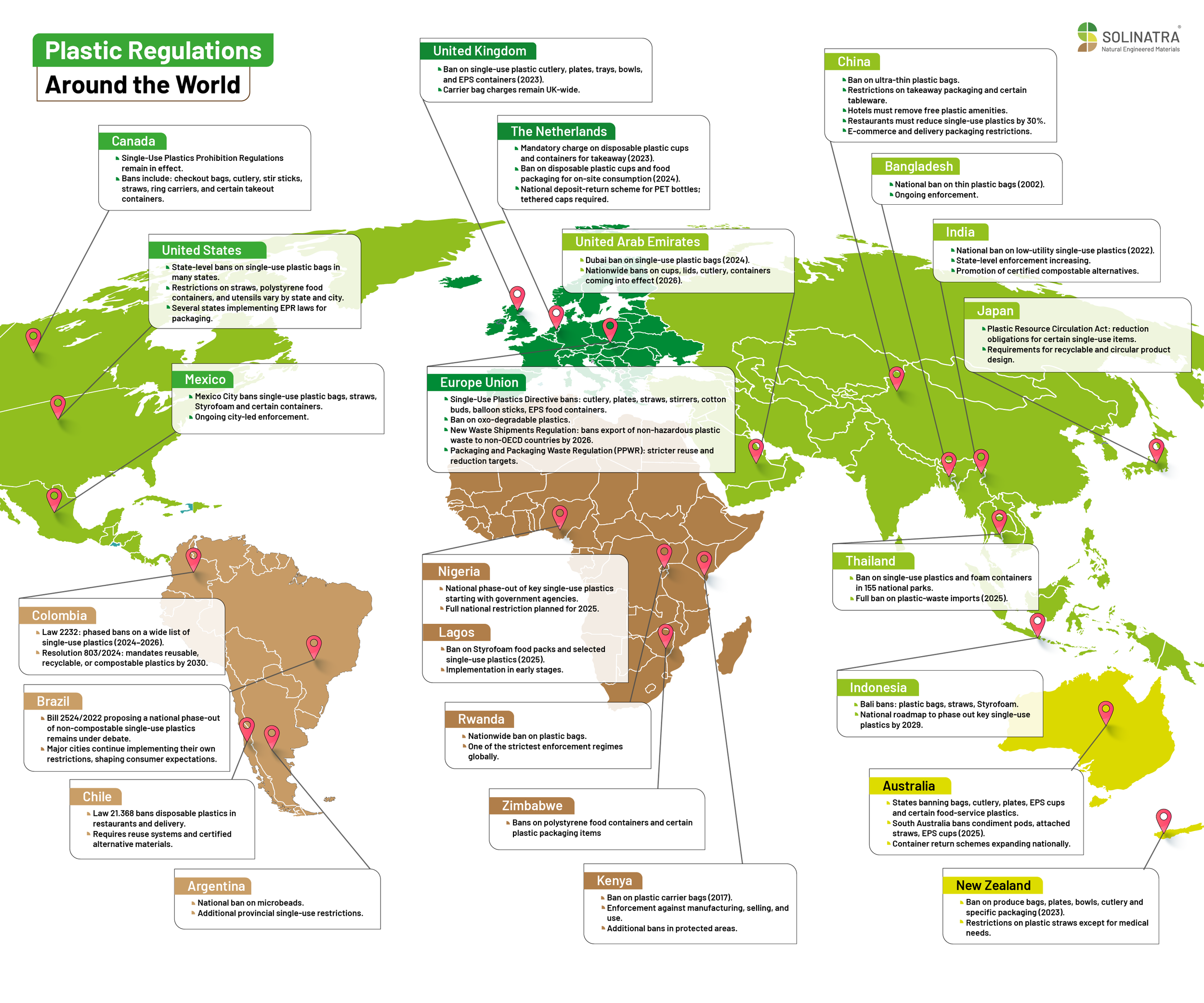
Global momentum to eliminate plastic pollution is accelerating, and 2025 marks one of the most active periods for new legislation targeting single-use plastics. As countries update bans, phase-outs and reuse mandates, the regulatory landscape is tightening for brands, retailers, foodservice operators and manufacturers.
Consumer pressure continues to rise. According to global studies, the majority of people want governments to restrict or eliminate single-use plastics. This shift is driving policymakers and businesses to adopt credible alternatives such as reusable systems and certified compostable materials.
This comprehensive 2025 report outlines the status of plastic bans worldwide, new legislation, regional updates, and the effectiveness of these policies, with verified sources for further reading.
Global Momentum: Status of the UN Plastics Treaty in 2025
In 2022, 175 nations agreed to develop a legally binding Global Plastics Treaty. Negotiations through 2024 and 2025, including Busan (2024) and Geneva (August 2025), did not produce a final agreement. Key disagreements remain on:
Production caps
Financing mechanisms
Definitions of high-risk plastics
Global versus national commitments
Despite this delay, many governments are moving forward with national bans, extended producer responsibility policies and strict packaging regulations. Businesses increasingly expect global alignment to arrive in the coming years, prompting faster adoption of circular and compostable material solutions today.
Plastic Bans by Country and Region
All regions below are updated with the latest high-level legislative changes, making this one of the most current publicly available summaries of global plastic bans.
European Union
Single-Use Plastics Directive bans: cutlery, plates, straws, stirrers, cotton buds, balloon sticks, EPS food containers, and oxo-degradable plastics.
New Waste Shipments Regulation : bans export of non-hazardous plastic waste to non-OECD countries by 2026.
Packaging and Packaging Waste Regulation (PPWR): stricter reuse and reduction targets.
The Netherlands
Disposable plastic cups and food containers for takeaway require a mandatory charge since July 2023.
From January 2024, disposable plastic cups and packaging are banned for on-site consumption in hospitality, offices and events.
PET bottles remain part of a national deposit-return system, with tethered caps required from 2024.
United Kingdom
England’s bans on cutlery, polystyrene food containers, plates, trays and bowls came into effect on 1 October 2023.
Bag charges continue across the UK, resulting in significant declines in consumption.
Indonesia
Continued bans in Bali on bags, straws and Styrofoam, with other provinces adopting similar rules.
Indonesia remains on track for its 2029 national phase-out of key single-use plastics.
China
China’s 2019–2025 roadmap restricts ultra-thin bags, takeaway containers and non-compliant packaging.
E-commerce and delivery companies face tighter obligations to minimise non-recyclable materials.
Hotels must eliminate free plastic amenities; restaurants must reduce single-use plastic by 30 percent.
Bangladesh
The 2002 thin plastic bag ban remains in effect and continues to influence legislation globally.
Enforcement is ongoing, with continued efforts to reduce illicit production.
India
The 2022 national ban on low-utility single-use plastics is still being scaled.
States continue strengthening enforcement and encouraging certified compostable materials.
Japan
The Plastic Resource Circulation Act continues requiring business operators to reduce certain disposable plastic items and improve circularity.
Thailand
Single-use plastics and foam containers are banned in 155 national parks.
Thailand fully banned imports of plastic waste for industrial use beginning January 2025.
United States
Bag bans in multiple states (New Jersey, Vermont, Oregon, California) collectively eliminate an estimated six billion plastic bags annually.
Multiple states have recently passed or expanded bans on polystyrene (EPS/Styrofoam) food containers: e.g. California, Oregon, Delaware, New Jersey, New York, Vermont, Washington among others
In 2025, many states introduced new packaging-related laws — including bans on certain single-use items and EPR requirements.
Canada
Single-Use Plastic Prohibition Regulation remain in effect
Bans include checkout bags, cutlery, stir sticks, straws, ring carriers, and certain takeout containers.
Plastic ban case keeps moving in Canadian court system — rules remain in place
Mexico
Mexico City maintains bans on bags, straws and single-use containers.
Enforcement continues with support for compostable and reusable systems.
Rwanda
Rwanda maintains one of the strictest national bans on plastic bags.
Kenya
Kenya’s carrier bag ban significantly reduced plastic litter.
Zimbabwe
Zimbabwe’s bans on polystyrene food containers and certain packaging items
Argentina
Argentina’s microbeads ban remains in place, with further provincial action on single-use plastics emerging.
Brazil
Bill 2524/2022 proposing a national phase-out of non-compostable single-use plastics remains under debate.
Major cities continue implementing their own restrictions, shaping consumer expectations.
Colombia
Law 2232 of 2022 entered major implementation stages in 2024 and early 2025. Bans on supermarket bags and several other items took effect in July 2024. Additional bans apply in January 2025 and 2026.
Resolution 803 of 2024 mandates that by 2030 most single-use plastics must be reusable, recyclable, compostable or made with locally sourced recycled content.
Australia
States continue to expand bans on bags, cutlery, plates, EPS cups, and more.
South Australia introduced world-first bans on small condiment pods, EPS cups and more in 2025.
Container return schemes expanding nationally.
United Arab Emirates
Dubai banned single-use plastic bags in January 2024.
Nationwide bans on cups, lids, cutlery, containers and more will apply from January 2026.
Nigeria and Lagos
Nigeria announced a phased national ban on key single-use items beginning with public institutions and expanding nationwide in 2025.
Lagos began enforcing bans on Styrofoam and single-use plastics in July 2025.
Chile
Law 21.368 bans disposable plastics across restaurants and delivery services and requires reuse systems and certified alternatives.
Requires reuse systems and certified alternative materials.
New Zealand
From July 2023, New Zealand banned single-use produce bags, plates, bowls, cutlery and restricted access to plastic straws except for medical needs.
Builds on earlier bans on stirrers, cotton buds and polystyrene packaging.