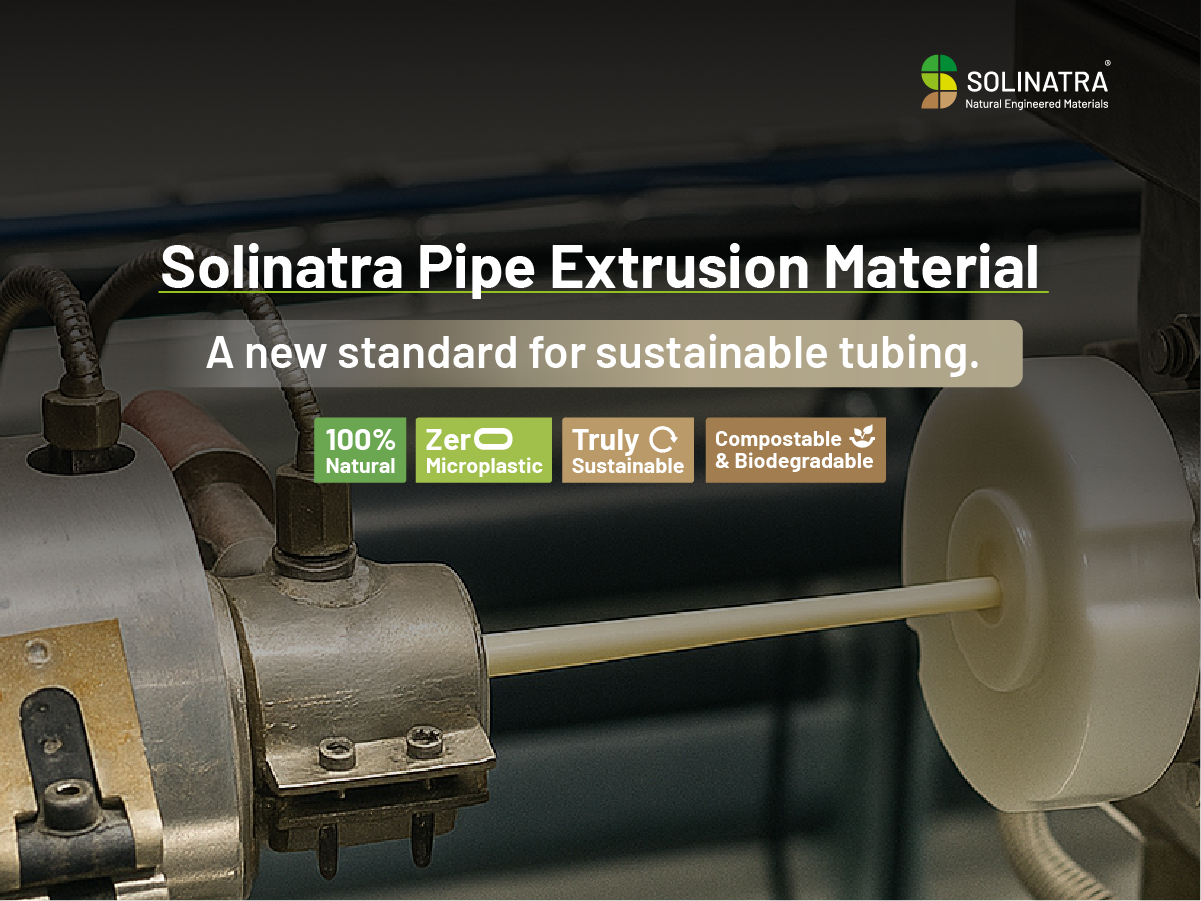
Solinatra Pipe Extrusion Materials: Unlocking a New Class of Sustainable Tubing

As industries move away from short-life plastics, the demand for safe and scalable sustainable materials continues to grow. Solinatra provides an extrusion material that allows manufacturers to create high-quality tubes, microtubes, and pipe-shaped products using standard equipment. It delivers stability, clean processing, and reliable performance across a wide range of short-life applications, including drinkware, horticultural tubing, fluid-transfer components, and other tube-based products.

The material performs with the clarity and precision expected from modern manufacturing while avoiding the long-term impact of petroleum plastics. It is plant based, compostable, and compatible with natural colouring, making it a practical solution for brands looking to reduce plastic without changing how they produce.

What Makes Solinatra Pipe Extrusion Material Different

Solinatra’s extrusion grade has been engineered to run smoothly on conventional lines. The compound delivers consistent melt flow, strong dimensional stability, and a clean surface finish that supports both thin-wall and thick-wall formats.

Key Benefits

·       High stability during continuous extrusion

·       Smooth, uniform surface quality

·       Predictable flow behaviour for high-speed production

·       100% natural, compostable and biodegradable

·       Compatible with natural pigments for clean, safe colouring


Applications Across Multiple Industries

1. Sustainable Drinkware Tubes

Global demand for plastic-free drinkware and food-service accessories is expanding quickly. As regulations continue to tighten, food chains, airlines, and beverage brands are sourcing materials that provide a better consumer experience while meeting compliance standards.

2. Horticultural Irrigation Tubes and Microtubes

Growers are increasingly seeking options that reduce the risk of microplastic contamination. Short-life irrigation tubes, seedling propagation microtubes, and nursery accessories are rapidly transitioning toward renewable alternatives. Solinatra offers a compostable, soil-safe solution for these high-volume items.

3. Fluid-Transfer Tubing for Food and Laboratory Use

Industries relying on single-use transfer tubes can shift to a cleaner, renewable alternative without process redesign. Solinatra offers the rigidity and precision needed for consistent small-diameter tubing.

4. Craft, Medical, and Specialty Short-Life Tubes

Craft, medical, and specialty applications often depend on precise short-life tubes for handling, dispensing, or assembly. Solinatra provides a renewable alternative that maintains accuracy and reliability. The material supports clean, consistent small-diameter extrusion while reducing the impact of single-use plastics.

Natural Colouring for Clean and Customisable Aesthetics

Solinatra can be coloured using natural pigments, supporting soft earth tones and brighter brand colours without synthetic dyes. This gives manufacturers a strong sustainability narrative without compromising visual identity.


Market Momentum, The Demand Is Accelerating

1. Surge in Demand for Sustainable Drinkware

Global regulations continue to restrict single-use plastics, with policies such as the EU Single-Use Plastic Directive removing plastic straws, stirrers, and cutlery from the market. In the United States, multiple states including California, Oregon, and Washington are strengthening their own restrictions.

Consumer behaviour is reinforcing this momentum, pushing major food-service and beverage brands toward cleaner material choices. This shift is reflected in market data showing strong growth in the compostable straw segment, with rising demand for plant-based, high-performance alternatives.

2. Increasing Pressure for Sustainable Horticultural Tubing

Agriculture is increasingly shifting toward safer, cleaner materials as awareness grows around soil microplastic contamination and long-term land health. Studies such as the FAO report on microplastics in agriculture highlight how conventional plastics accumulate in soil over repeated growing cycles.

Industry discussions continue to call for alternatives, with platforms like HortiDaily reporting frequent updates on sustainable irrigation and nursery solutions, and the European Seed Association sharing insights on reducing plastic within propagation systems. Irrigation microtubes, seedling tubes, and nursery accessories are now a central focus as growers look for clean, compostable options.

3. Businesses Prioritising Verified Sustainability Claims

Companies are placing greater emphasis on credible sustainability reporting, particularly around Scope 3 emissions and the reduction of plastics in day-to-day operations. Insights from EY’s sustainability analysis show that organisations are under rising pressure to demonstrate real, measurable progress rather than broad commitments.

4. Expansion of the Bioplastics Market

Market data shows steady and significant growth in compostable materials and bio-based polymers as brands continue moving away from fossil-based plastics. Updates from European Bioplastics highlight increasing production capacity across the sector, driven by regulation, consumer preference, and industry adoption.

This momentum is further supported by long-term projections, including the global bioplastics forecast for 2023–2030, which anticipates ongoing expansion as manufacturers integrate renewable materials into more product categories.

Download our material specification
Speak with our material experts
Next
Next

Plastic Regulations Around the World: The Complete 2025 Global Overview